what percentage of all commercial banks in the united states belong to the federal reserve system?
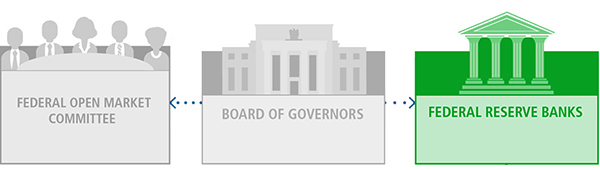
Pursuant to the Federal Reserve Human action, each of the 12 Reserve Banks is separately incorporated and has a ix-fellow member board of directors.
Commercial banks that are members of the Federal Reserve System concur stock in their District's Reserve Bank and elect six of the Reserve Banking concern'southward directors; three remaining directors are appointed past the Board of Governors. Most Reserve Banks have at least 1 Branch, and each Co-operative has its own lath of directors. Branch directors are appointed by either the Reserve Bank or the Board of Governors.
Directors serve as a link between the Federal Reserve and the private sector. As a grouping, directors bring to their duties a broad variety of experiences in the private sector, which gives them invaluable insight into the economic weather of their respective Federal Reserve Districts. Reserve Banking company head-office and Branch directors contribute to the System'south overall understanding of the economy.
The Federal Reserve is non funded past congressional appropriations. Its operations are financed primarily from the involvement earned on the securities it owns--securities acquired in the form of the Federal Reserve's open market operations. The fees received for priced services provided to depository institutions, such as bank check clearing, funds transfers, and automated clearinghouse operations, are another source of income; this income is used to cover the cost of those services. After payment of expenses and transfers to surplus (limited to an aggregate of $ten billion), all the net earnings of the Federal Reserve Banks are transferred to the U.S. Treasury.
Federal Reserve cyberspace earnings are paid to the U.S. Treasury
The Federal Reserve transfers its cyberspace earnings to the U.South. Treasury. 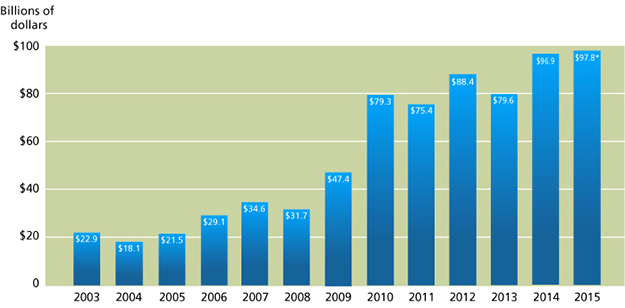
Despite the demand for coordination and consistency throughout the Federal Reserve Organization, geographic distinctions remain important. Effective monetary policymaking requires knowledge and input about regional differences. For case, two directors from the same industry may have different opinions regarding the forcefulness or weakness of that sector depending on their regional perspectives. The decentralized structure of the Organisation and its alloy of private and public characteristics, envisioned by the Arrangement'due south creators, therefore, remain of import features today.
Structure and Function
The 12 Federal Reserve Banks and their 24 Branches are the operating arms of the Federal Reserve System. Each Reserve Bank operates within its own particular geographic area, or district, of the United States.
Each Reserve Bank gathers data and other information about the businesses and the needs of local communities in its region. That information is and then factored into monetary policy decisions by the FOMC and other decisions made by the Board of Governors.
Reserve Banking company Leadership
Equally gear up forth in the Federal Reserve Act, each Reserve Depository financial institution is subject to "the supervision and command of a board of directors." Much like the boards of directors of individual corporations, Reserve Bank boards are responsible for overseeing their Banking company's administration and governance, reviewing the Bank's budget and overall operation, overseeing the Depository financial institution's audit process, and developing broad strategic goals and directions. Still, different private corporations, Reserve Banks are not operated in the involvement of shareholders, only rather in the public interest.
Each year, the Board of Governors designates one chair and one deputy chair for each Reserve Bank from among its Class C directors. The Federal Reserve Deed requires that the chair of a Reserve Bank'southward lath be a person of "tested banking experience," a term which has been interpreted as requiring familiarity with cyberbanking or financial services.
Each Reserve Bank board delegates responsibility for day-to-day operations to the president of that Reserve Bank and his or her staff. Reserve Depository financial institution presidents act equally chief executive officers of their respective Banks and as well serve, in rotation, every bit voting members of the FOMC. Presidents are nominated past a Bank'south Class B and C directors and approved by the Board of Governors for v-twelvemonth terms.
Reserve Bank Branches also accept boards of directors. Pursuant to policy established by the Lath of Governors, Co-operative boards must have either five or seven members. All Branch directors are appointed: the majority of directors on a Branch board are appointed by the lath of directors of the Reserve Banking company, and the remaining directors on the board are appointed by the Lath of Governors. Each Branch board selects a chair from amongst those directors appointed by the Board of Governors. Unlike Reserve Depository financial institution directors, Co-operative directors are not divided into different classes. However, Branch directors must encounter different eligibility requirements, depending on whether they are appointed past the Reserve Bank or the Board of Governors.
Reserve Banking concern and Branch directors are elected or appointed for staggered iii-yr terms. When a director does not serve a full term, his or her successor is elected or appointed to serve the unexpired portion of that term.
Reserve Bank Responsibilities
The Reserve Banks carry out Federal Reserve core functions by
- supervising and examining state fellow member banks (state-chartered banks that accept chosen to become members of the Federal Reserve System), bank and thrift holding companies, and nonbank financial institutions that have been designated every bit systemically important nether authority delegated to them by the Lath;
- lending to depository institutions to ensure liquidity in the financial system;
- providing key fiscal services that undergird the nation's payment organisation, including distributing the nation's currency and coin to depository institutions, clearing checks, operating the FedWire and automatic clearinghouse (ACH) systems, and serving as a bank for the U.Southward. Treasury; and
- examining certain financial institutions to ensure and enforce compliance with federal consumer protection and fair lending laws, while besides promoting local community development.
In its role providing key financial services, each Reserve Bank acts, essentially, as a financial institution for the banks, thrifts, and credit unions in its District--that is, each Reserve Banking concern acts as a "bank for banks." In that capacity, it offers (and charges for) services to these depository institutions similar to those that ordinary banks provide their individual and business customers: the equivalent of checking accounts; loans; coin and currency; safekeeping services; and payment services (such as the processing of checks and the making of recurring and nonrecurring small- and large-dollar payments) that help banks, and ultimately their customers, buy and sell goods, services, and securities.
In addition, through their leaders and their connections to, and interactions with, members of their local communities, Federal Reserve Banks provide the Federal Reserve Arrangement with a wealth of information on conditions in virtually every part of the nation--information that is vital to formulating a national budgetary policy that will help to maintain the health of the economic system and the stability of the nation's financial system.
Sure information gathered past the Reserve Banks from Reserve Bank directors and other sources is also shared with the public prior to each FOMC coming together in a report commonly known as the Beige Book. In addition, every two weeks, the lath of each Reserve Bank recommends discount rates (interest rates to be charged for loans to depository institutions made through that Depository financial institution's disbelieve window); these involvement charge per unit recommendations are subject to review and determination by the Board of Governors.
Federal Reserve Authoritative Manual - Employee Carry (PDF)
Dorsum to Top
Last Update: October 01, 2021
Source: https://www.federalreserve.gov/aboutthefed/structure-federal-reserve-banks.htm
0 Response to "what percentage of all commercial banks in the united states belong to the federal reserve system?"
Post a Comment