Who Is the Speaker of the House of Representatives Australia
| Speaker of the Business firm of Representatives | |
|---|---|
 | |
| Incumbent | |
| Style | The Honourable (Formal and Diplomatic) Mister/Madam Speaker (Informal and inside the House) |
| Appointer | Elected by the House of Representatives |
| Term length | At the pleasure of the House Elected by the House at the starting time of each Parliament, and upon a vacancy |
| Constituting instrument | Section 35 of the Constitution of Commonwealth of australia |
| Inaugural holder | Sir Frederick Holder 9 May 1901 |
| Germination | nine July 1900 |
| Deputy | Llew O'Brien (since x February 2020) |
| Bacon | $369,700 (2019–20)[1] |
The Speaker of the House of Representatives is the presiding officer of the Firm of Representatives, the lower house of the Parliament of Australia. The presiding officer in the upper house is the President of the Senate. The office of Speaker was created by department 35 of the Constitution of Commonwealth of australia. The authors of the Constitution intended that the House of Representatives should equally nearly every bit possible be modelled on the House of Commons of the United Kingdom.
The Speaker is the presiding officer of House of Representatives debates, determining which members may speak. The Speaker is also responsible for maintaining gild during debate, and may punish members who suspension the rules of the House.
The part of Speaker is currently Andrew Wallace, who was elected Speaker on 23 November 2021. The Deputy Speaker is Llew O'Brien (National), who was elected Deputy Speaker on 10 February 2020.[2] If the Speaker is absent the Deputy Speaker becomes the Acting Speaker. The Second Deputy Speaker is Rob Mitchell (Labor).
Election [edit]
The Speaker is elected past the House of Representatives in a secret ballot, with an election held whenever the Office of the Speaker is vacant, as set up out in Affiliate 3 of the Business firm of Representatives Standing and Sessional Orders. The Clerk of the Australian House of Representatives conducts the election. The MPs who move and second the nomination of the successful candidate "drag" them to the chair after his ballot, in accordance with a tradition carried over from Westminster.
Unlike the Speaker of the House of Commons in Britain, the Speaker generally remains an active member of their political party. If a party member, the Speaker volition go along to attend party meetings, and at general elections volition stand up as a party candidate. There were two exceptions to this: the first Speaker, Frederick Holder (1901) and Peter Slipper (2011), who resigned from their corresponding parties upon ballot equally Speaker, and sabbatum as independents.
A Speaker ceases to concord that office if, for any reason, they cease to exist a fellow member of the House. At that place is no convention in Commonwealth of australia that the Speaker should not be opposed in their seat, and iii Speakers have been defeated at general elections: Littleton Groom (1929), Walter Nairn (1943) and William Aston (1972). Considering the Speaker is e'er the nominee of the governing party, there is no expectation that a Speaker will continue in office following a modify of authorities. While the Opposition unremarkably nominates ane of its ain members for Speaker after a general election, this is understood to be a symbolic human action, and party subject field is always followed in whatever election.
By reason of section 40 of the Constitution, while in the Chair, a Speaker does non have a deliberative vote, but if there is a tie in votes, the Speaker has a tiebreaker vote.
Most Speakers accept been senior backbenchers of the political party property office at the start of a new Parliament, or at the time of the death or resignation of an incumbent Speaker. Five Speakers accept been former government ministers: William Watt, Littleton Groom, Archie Cameron, Ian Sinclair and Bronwyn Bishop; one a quondam Parliamentary Secretarial assistant: Stephen Martin; and one both a former minister and a former Leader of the Opposition: Billy Snedden. Ii were old state premiers: Holder and Watt. There is no convention in Australia that Speakers should resign from Parliament at the end of their term; two Speakers have go Cabinet ministers after having been Speaker: Norman Makin and Gordon Scholes.
Bronwyn Bishop was elected Speaker on 12 November 2013, as the Coalition's first female Speaker of the Firm and the third female Speaker, later on Labor'south Joan Kid (1986–89) and Anna Burke (2012–13). The 43rd Parliament (2010–13) was the first Australian federal parliament to take had 3 Speakers: Harry Jenkins (elected September 2010), Peter Slipper (Nov 2011), and Anna Burke (October 2012).
All male person Speakers have been addressed by members as "Mister Speaker" while in the Chair. Joan Child chose to be addressed as "Madam Speaker", as female Speakers are ordinarily referred to in other parliaments. Anna Burke broke with this tradition and ruled that her official form of address is merely "Speaker."
Role [edit]

The Speaker's chair in the House of Representatives
The Speaker'south chief duty is to preside over the House and maintain club in the House, uphold Standing Orders (rules of procedure), rule on points of order, and protect the rights of backbench members.
Australian parliaments are notoriously rowdy, and the Speaker frequently exercises the disciplinary powers vested in them under Standing Orders. The Speaker may summarily order a Member to excuse themself from the House for 1 60 minutes. For more serious offences, the Speaker may "name" a Fellow member, maxim "I name the Honourable Member for 10," following the House's convention that Members are always referred to by their electorate. The House then votes on a motion to suspend the Member for 24 hours. (The House too had the ability to permanently miscarry a Member, merely this happened only in one case, in 1920: the member was Hugh Mahon. The Business firm no longer has the ability to miscarry a fellow member from membership of the Business firm under Section 8 of the Parliamentary Privileges Act 1987.[three])
The Speaker, in conjunction with the President of the Senate, also administers Parliament Firm, Canberra, with the assistance of an administrative staff in the Australian parliamentary departments. The Speaker has accountability obligations to the Parliament for the Department of the House of Representatives.
A member of the Firm who wishes to resign would tender their resignation to the Speaker (just not to an Acting Speaker), or if there is no Speaker to the Governor-General. During the Joint Sitting of 1974 the Speaker of the Australian Firm of Representatives Jim Cope was the presiding officer.
Impartiality [edit]
While impartial, the Speaker does not ordinarily quit the membership of their party similar the Speaker of the House of Commons. Although the beginning Speaker, Sir Frederick Holder, resigned from the Gratis Merchandise Party upon taking the role in accordance with traditional Westminster convention, subsequent speakers did not follow this convention. The only other speaker to engagement who resigned from their party was Peter Slipper, chosen from the opposition, who resigned from the Liberal Party the day after his election to the chair.
On the other hand, the Speaker is not an active political effigy similar the Speaker of the United States House of Representatives. They practise not take part in debates in the House, do not vote in the Firm except in the (rare) event of a tied vote, and do non speak in public on political party-political issues (except at election time in their own constituency). They are expected to conduct the business of the House in an impartial manner, and generally practice so.
At that place take been several memorable clashes between Speakers and the governments:
- In 1929 Speaker Littleton Groom declined to come into the House and cast a vote in committee when his vote would have saved the Bruce authorities from defeat. Equally a consequence, he was expelled from the Nationalist Political party and defeated in his constituency at the subsequent election.
- In 1975 the Whitlam government refused to support Speaker Jim Cope when he named government minister Clyde Cameron for boldness to the Chair: commonly this would have resulted in the minister's suspension from the House. The Speaker resigned on the spot. This is the only occasion on which a Regime failed to support a Speaker afterward a Member had been named.[iv]
- In 1982 Speaker Billy Snedden refused to insist that an opposition frontbencher, Bob Hawke, retract an accusation that the Prime Minister, Malcolm Fraser, was a liar. Snedden stood his basis despite furious demands from authorities members that Hawke either be fabricated to retract or be named.
- In 2011, a Speaker survived beingness countermanded past the Business firm. Later on a contentious debate on carbon pricing in which Speaker Harry Jenkins declared a "general warning" for all members, Liberal MP Bob Baldwin interjected and was named by the Speaker. The Regime accordingly moved that he exist suspended, but Baldwin was supported by the Coalition, independent MP Rob Oakeshott and WA Nationals MP Tony Crook. The resulting vote on suspending Baldwin for 24 hours failed 71–72. Convention would normally have required the Speaker to resign, but the House of Representatives immediately thereafter approved a motion of conviction in the Speaker, and as a consequence, Speaker Jenkins continued in office.[five] [6] [7] [8]
Speakers of or from opposition parties [edit]
While speakers normally come up from the governing political party, there have been several exceptions.
Peter Slipper was a member of the Liberal Party when elected as Speaker, just resigned a solar day later. Slipper's peak to the speakership occurred due to the hung parliament resulting from the 2010 election, which saw the ALP form a minority government.
In the previous hung parliament elected at the 1940 election, the United Australia Party's Walter Nairn continued equally Speaker when the ALP formed a new government in the heart of the parliamentary term.
Opposition MP Carty Salmon initially served as speaker for the outset federal Australian bulk authorities, the Andrew Fisher Labor regime, resulting from the 1910 ballot.
At the 1913 election, Labor's Charles McDonald was offered retention of the Speakership past the incoming one-seat-majority Commonwealth Liberal Party, but declined – after withal, afterward Labor'due south return to government at the 1914 election, McDonald regained the Speakership until the subsequent election in 1917 despite the mid-term change to a Nationalist Party government.[nine] [10]
Entitlements [edit]
The speaker's salary is determined by the Remuneration Tribunal, an independent statutory body. Equally of ane July 2019, the incumbent is entitled to a parliamentarian's base salary of A$211,250 plus an boosted 75% loading, equating to a salary of approximately $369,700. Assuming they hold no other positions, the deputy speaker has a salary of $253,500 (20% loading), the second deputy speaker $238,700 (13% loading), and members of the speaker's console $217,600 (3% loading).[1]
A member elected speaker is entitled to the title "The Honourable" while in role, which, with the approving of the Queen of Commonwealth of australia, may be retained for life. This privilege is ordinarily only given to those who have served every bit speaker for at to the lowest degree three years. Harry Jenkins Jr. was the first speaker to ask that "The Honourable" title not be used in reference to him, while also making clear that he was not attempting to gear up a precedent for future speakers; he was just not personally comfortable with the title.[ commendation needed ]
Official apparel [edit]
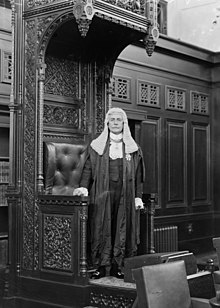
Post-obit the Westminster tradition inherited from the House of Commons of the United kingdom, the traditional clothes of the Speaker includes components of Courtroom dress such as a black silk lay-type gown (like to a Queen's Counsel gown), a wing collar and a lace jabot or bands (another variation included a white bow tie with a lace jabot), bar jacket, and a full-bottomed wig. The wig available for utilise past the speaker was used by Herbert 'Doc' Evatt when he was a High Courtroom Justice (1930–1940) and was donated to the Parliament by Evatt when he was elected to the House in 1951. The wig is currently on loan from the speaker's office to the Museum of Australian Democracy.[11] Another addition used past before speakers, though only for the nearly formal occasions, included court shoes and hose.
The clothes of Speakers has frequently varied according to the party in ability, merely is adamant on the personal choice of the Speaker. Most not-Labor Speakers have worn some variation of the traditional dress. All Labor Speakers have eschewed the traditional apparel in favour of ordinary concern attire as appropriate for a fellow member of parliament, following the case set up by their starting time Speaker, Charles McDonald.
Billy Snedden (1976–1983) was the last Speaker to habiliment the total traditional attire of the Speaker, complete with the wig. On the election of the Howard Government in 1996, the new Speaker, Bob Halverson, chose to wearable the traditional court dress of the Speaker upon his election in Apr 1996, but without the wig.[12] Speaker Ian Sinclair opted to wear a gown, albeit of a simpler academic manner, during his brief term in 1998, a do mirrored by his successors, Neil Andrew and David Bell-ringer. Speaker Harry Jenkins resumed Labor exercise from 2007 until the election of Peter Slipper in late 2011. Slipper went a step toward restoring the traditional dress past wearing a gown and bar jacket underneath his concern attire. Slipper likewise took to wearing a white long tie or bow necktie, in a variation from the lace jabot or bands.[11] For example, he wore a wing neckband with white bow tie and bands on the occasion of his first formal procession into parliament.[xiii] Speaker Anna Burke resumed Labor practice afterwards beingness elected to succeed Slipper in 2012. Speaker Bronwyn Bishop, the get-go not-Labor woman to hold the post, connected wearing business attire with no gown later on the Abbott Regime installed her in 2013. The incumbent speaker, Andrew Wallace, has likewise opted for business attire.
List of speakers of the House of Representatives [edit]
The following is a list of speakers of the House of Representatives.[14]
| # | Proper name | Party | Country | Term starting time | Term end | Term in office | |
|---|---|---|---|---|---|---|---|
| one | Frederick Holder | Contained | South Australia | 9 May 1901 | 23 July 1909 | eight years, 75 days | |
| two | Carty Salmon | Republic Liberal | Victoria | 28 July 1909 | nineteen February 1910 | 206 days | |
| iii | Charles McDonald | Labor | Queensland | 1 July 1910 | 23 Apr 1913 | two years, 296 days | |
| 4 | Elliot Johnson | Commonwealth Liberal | New S Wales | nine July 1913 | 30 July 1914 | 1 year, 21 days | |
| (iii) | Charles McDonald | Labor | Queensland | 8 October 1914 | 26 March 1917 | 2 years, 169 days | |
| (4) | Elliot Johnson | Nationalist | New S Wales | 14 June 1917 | six November 1922 | v years, 145 days | |
| 5 | William Watt | Nationalist | Victoria | 28 February 1923 | 3 October 1925 | 2 years, 217 days | |
| half-dozen | Littleton Groom | Nationalist | Queensland | 13 January 1926 | 16 September 1929 | 3 years, 246 days | |
| 7 | Norman Makin | Labor | Due south Australia | 20 November 1929 | 27 November 1931 | two years, seven days | |
| 8 | George Mackay | United Australia | Queensland | 17 February 1932 | vii Baronial 1934 | 2 years, 171 days | |
| 9 | George Bell | United Commonwealth of australia | Tasmania | 23 October 1934 | 27 August 1940 | 5 years, 309 days | |
| x | Walter Nairn | United Commonwealth of australia | Western Commonwealth of australia | twenty November 1940 | 21 June 1943 | 2 years, 213 days | |
| 11 | Sol Rosevear | Labor | New Due south Wales | 22 June 1943 | 31 October 1949 | six years, 131 days | |
| 12 | Archie Cameron | Liberal | South Commonwealth of australia | 22 February 1950 | nine August 1956 | 6 years, 169 days | |
| 13 | John McLeay | Liberal | South Australia | 29 August 1956 | 31 October 1966 | 10 years, 63 days | |
| 14 | William Aston | Liberal | New South Wales | 21 February 1967 | 2 November 1972 | 5 years, 255 days | |
| 15 | Jim Cope | Labor | New South Wales | 27 February 1973 | 27 February 1975 | two years, 0 days | |
| xvi | Gordon Scholes | Labor | Victoria | 27 Feb 1975 | 11 November 1975 | 257 days | |
| 17 | Billy Snedden | Liberal | Victoria | 17 February 1976 | 4 Feb 1983 | half dozen years, 352 days | |
| eighteen | Harry Jenkins Sr. | Labor | Victoria | 21 April 1983 | 20 Dec 1985 | 2 years, 243 days | |
| 19 | Joan Child | Labor | Victoria | eleven February 1986 | 28 August 1989 | 3 years, 198 days | |
| 20 | Leo McLeay | Labor | New South Wales | 29 August 1989 | viii Feb 1993 | 3 years, 163 days | |
| 21 | Stephen Martin | Labor | New South Wales | 4 May 1993 | 29 January 1996 | 2 years, 270 days | |
| 22 | Bob Halverson | Liberal | Victoria | xxx Apr 1996 | 3 March 1998 | 1 twelvemonth, 307 days | |
| 23 | Ian Sinclair | National | New S Wales | 4 March 1998 | 31 August 1998 | 180 days | |
| 24 | Neil Andrew | Liberal | S Commonwealth of australia | ten Nov 1998 | 31 August 2004 | five years, 295 days | |
| 25 | David Hawker | Liberal | Victoria | 16 Nov 2004 | 17 October 2007 | 2 years, 335 days | |
| 26 | Harry Jenkins Jr. | Labor | Victoria | 12 Feb 2008 | 24 Nov 2011 | 3 years, 285 days | |
| 27 | Peter Slipper | Independent | Queensland | 24 November 2011 | 9 Oct 2012 | 320 days | |
| 28 | Anna Burke | Labor | Victoria | 9 October 2012 | 12 November 2013 | 1 twelvemonth, 34 days | |
| 29 | Bronwyn Bishop | Liberal | New South Wales | 12 November 2013 | ii August 2015 | i yr, 263 days | |
| thirty | Tony Smith | Liberal | Victoria | 10 August 2015 | 23 November 2021 | six years, 105 days | |
| 31 | Andrew Wallace | Liberal | Queensland | 23 November 2021 | Incumbent | 87 days | |
Assistants to the speaker [edit]
The House selects two of its members to serve as deputy speaker and 2d deputy speaker. The speaker also nominates a number of other MPs as assistants, who form the speaker's console. In order for business concern to proceed, the House may choose any member to take the chair if the speaker is absent and the previously deputised members are unavailable; this is rare. Whatever member chairing the House in the absence of the speaker or deputy speakers is addressed every bit "Acting Deputy Speaker". Nonetheless, only the deputy and second deputy speakers can serve as "acting speaker", with the full powers of the position.[fifteen]
Deputy speaker [edit]

The position of deputy speaker was created in 1994 in place of the quondam position of "chairman of committees", which had existed since the first parliament in 1901. This coincided with the institution of the Main Committee (now renamed the Federation Sleeping room). As with the speakership, the deputy speakership is usually held by a government MP. The deputy speaker has the same procedural powers every bit the speaker while in the chair, including signing messages from the House to the Senate. As well as deputising for the speaker, the deputy speaker chairs the Federation Bedchamber.[15]
The current deputy speaker is Llew O'Brien, who was elected to the position on x February 2020. Unusually, the government's nominee was defeated in the election, with O'Brien – nonetheless a government MP – winning election with the support of the opposition and a modest number of government defectors.[16]
List of deputy speakers and chairmen of committees [edit]
The title of the function was originally "chairman of committees". This was inverse to "deputy speaker and chairman of committees" on 3 November 1992 and to merely "deputy speaker" on 21 February 1994. The terms of deputy speakers technically coincide with terms of parliament, withal for the purposes of the table beneath terms spanning multiple parliaments are deemed to exist continuous. Prior to ten July 1907 the chairman of committees was elected on a sessional basis.[17]
| # | Proper name | Party | Country | Term start | Term end | Term in office | |
|---|---|---|---|---|---|---|---|
| 1 | John Chanter | Protectionist | New South Wales | 5 June 1901 | 22 Oct 1903 | ii years, 139 days | |
| 2 | Carty Salmon | Protectionist | Victoria | 17 March 1904 | 21 December 1905 | 1 yr, 279 days | |
| 3 | Charles McDonald | Labor | Queensland | xx June 1906 | 19 February 1910 | 3 years, 244 days | |
| 4 | Alexander Poynton | Labor | Due south Australia | i July 1910 | 23 April 1913 | 2 years, 296 days | |
| five | James Fowler | Liberal | Western Commonwealth of australia | ix July 1913 | 30 July 1914 | 1 year, 21 days | |
| (ane) | John Chanter | Labor | New South Wales | 9 Oct 1914 | vi Nov 1922 | eight years, 28 days | |
| National Labor | |||||||
| Nationalist | |||||||
| 6 | Fred Bamford | Nationalist | Queensland | 28 February 1923 | 3 October 1925 | ii years, 217 days | |
| 7 | James Bayley | Nationalist | Queensland | 14 January 1926 | sixteen September 1929 | 3 years, 245 days | |
| 8 | Charles McGrath | Labor | Victoria | 20 November 1929 | 27 November 1931 | two years, 7 days | |
| United Australia | |||||||
| 9 | George Bell | United Australia | Tasmania | 17 February 1932 | vii Baronial 1934 | two years, 171 days | |
| ten | John Prowse | Land | Western Australia | 23 October 1934 | 21 June 1943 | 8 years, 241 days | |
| xi | Pecker Riordan | Labor | Queensland | 22 June 1943 | 16 August 1946 | iii years, 55 days | |
| 12 | Joe Clark | Labor | New South Wales | 7 November 1946 | 31 October 1949 | 2 years, 358 days | |
| 13 | Charles Adermann | State | Queensland | 22 February 1950 | 14 October 1958 | eight years, 234 days | |
| fourteen | George Bowden | Country | Victoria | 17 February 1959 | 7 March 1961 | 2 years, eighteen days | |
| 15 | Philip Lucock | Country | New South Wales | 8 March 1961 | 2 Nov 1972 | 11 years, 239 days | |
| 16 | Gordon Scholes | Labor | Due south Australia | 28 February 1973 | 27 February 1975 | ane yr, 364 days | |
| 17 | Joe Berinson | Labor | Western Commonwealth of australia | 27 February 1975 | 14 July 1975 | 137 days | |
| xviii | Harry Jenkins Sr. | Labor | Victoria | 19 August 1975 | xi November 1975 | 84 days | |
| (xv) | Philip Lucock | National State | New South Wales | 17 Feb 1976 | ten November 1977 | one year, 266 days | |
| xix | Clarrie Millar | National Country | Queensland | 21 February 1978 | 4 Feb 1983 | 4 years, 348 days | |
| 20 | Les Johnson | Labor | New South Wales | 21 Apr 1983 | 19 December 1983 | 242 days | |
| 21 | Joan Child | Labor | Victoria | 28 February 1984 | eleven February 1986 | i year, 348 days | |
| 22 | Leo McLeay | Labor | New S Wales | 11 Feb 1986 | 29 August 1989 | three years, 199 days | |
| 23 | Ron Edwards | Labor | Western Commonwealth of australia | 29 August 1989 | viii Feb 1993 | iii years, 163 days | |
| 24 | Harry Jenkins Jr. | Labor | Victoria | four May 1993 | 29 January 1996 | 2 years, 270 days | |
| 25 | Garry Nehl | National | New South Wales | 30 April 1996 | 8 October 2001 | 5 years, 161 days | |
| 26 | Ian Causley | National | New South Wales | 12 February 2002 | 17 October 2007 | 5 years, 247 days | |
| 27 | Anna Burke | Labor | Victoria | 12 February 2008 | 19 July 2010 | two years, 157 days | |
| 28 | Peter Slipper | Liberal | Queensland | 28 September 2010 | 24 November 2011 | 1 year, 57 days | |
| (27) | Anna Burke | Labor | Victoria | 24 November 2011 | 9 October 2012 | 320 days | |
| 29 | Bruce Scott | National | Queensland | ix October 2012 | 9 May 2016 | 3 years, 213 days | |
| 30 | Mark Coulton | National | New Southward Wales | 30 Baronial 2016 | v March 2018 | 1 year, 187 days | |
| 31 | Kevin Hogan | National | New Southward Wales | 26 March 2018 | ten February 2020 | 1 year, 321 days | |
| 32 | Llew O'Brien | Liberal National | Queensland | ten February 2020 | Incumbent | 2 years, 8 days | |
| National | |||||||
Second deputy speaker [edit]
The position of second deputy speaker was created in 1994, primarily every bit an assistant to the deputy speaker in the Federation Chamber. The continuing orders of the Business firm state that only a non-government MP may be elected to the position. The runner-up in the ballot for the deputy speakership is deemed to have been elected 2d deputy speaker.[xviii] This procedure caused difficulty in the deputy speakership election held on 10 February 2020, in which both the winner Llew O'Brien and the runner-up Damian Drum were government MPs.[16]
List of 2d deputy speakers [edit]
The terms of second deputy speakers technically coincide with terms of parliament,[17] all the same for the purposes of the table below terms spanning multiple parliaments are accounted to be continuous.
| # | Name | Party | State | Term showtime | Term end | Term in function | |
|---|---|---|---|---|---|---|---|
| 1 | Allan Rocher | Liberal | Western Australia | iii March 1994 | 29 January 1996 | 1 twelvemonth, 332 days | |
| Independent | |||||||
| 2 | Harry Jenkins Jr. | Labor | Victoria | thirty April 1996 | 17 October 2007 | 11 years, 170 days | |
| 3 | Bruce Scott | National | Queensland | 12 February 2008 | 9 Oct 2012 | iv years, 240 days | |
| iii | Steve Georganas | Labor | South Australia | 10 October 2012 | five August 2013 | 299 days | |
| 4 | Rob Mitchell | Labor | Victoria | 12 Nov 2013 | Incumbent | 8 years, 98 days | |
Speaker's panel [edit]
The speaker's console consists of at least four MPs nominated past the speaker at the beginning of each parliament. The speaker may nominate additional members or revoke membership at any point during the parliament. Members of the console are called on to chair meetings of the House at the request of the speaker, every bit well as meetings of the Federation Sleeping accommodation at the request of the deputy speaker or second deputy speaker. A roster is maintained so that the chair can always be filled. Members of the console will relinquish the chair to the speaker or deputy speaker "if disorder arises or if special circumstances employ".[19]
Historically, the speaker has nominated both authorities and opposition MPs to the speaker's panel. However, after the 2010 and 2013 elections opposition members refused to serve on the panel. The do resumed later in the 2013–16 parliamentary term.[nineteen]
References [edit]
- ^ a b "Salary". Remuneration Tribunal. Retrieved 16 Feb 2020.
- ^ Doran, Matthew; Borys, Stephanie (10 February 2020). "Barnaby Joyce backer Llew O'Brien quits Nationals party room but to win a shock promotion". ABC News . Retrieved 10 February 2020.
- ^ Parliamentary Privileges Act 1987, Department eight.
- ^ Ian Harris, Clerk of the Business firm of Representatives (ed.). "The Speaker, Deputy Speaker, and officers". Firm of Representatives Do (PDF). Australian House of Representatives. p. 197. Retrieved 22 May 2011.
- ^ Democracy, Parliamentary Debates, House of Representatives, 31 May 2011, 5286–86.
- ^ Shanahan, Dennis (ane June 2011). "Oakeshott nearly brings downward the house". The Australian . Retrieved viii June 2011.
- ^ "Coalition takes credit for saving Speaker". ABC News. one June 2011. Retrieved viii June 2011.
- ^ Osbourne, Paul (31 May 2011). "Abbott averts Speaker crisis". The Sydney Morning Herald . Retrieved 8 June 2011.
- ^ "Appendix ii Speakers of the House of Representatives". Firm of Representatives Exercise Fifth Edition. Parliament of Commonwealth of australia. Retrieved 26 November 2011.
- ^ Megalogenis, George (25 November 2011). "Rats prepared to ditch their parties to survive". The Australian . Retrieved 26 November 2011.
- ^ a b Miller, Barbara (8 Feb 2012). "Pomp-seeker Slipper told to go on with job". ABC News . Retrieved 9 February 2012.
- ^ Commonwealth Hansard, Parliamentary Debates, Firm of Representatives Archived 23 November 2011 at the Wayback Auto, 30 April 1996, 7.
- ^ Griffiths, Emma (xiv February 2012). "New procession ushers in Slipper era". ABC News . Retrieved 14 February 2012.
- ^ "Historical Information". Parliamentary Handbook of the Republic of Australia (22nd ed.). Parliament of Australia. 2011. p. 602.
- ^ a b "Deputy Speaker". House of Representatives Do (7th ed.). Parliament of Australia. Retrieved 13 Feb 2020.
- ^ a b "Morrison government loses shock vote on deputy speaker". The Australian Financial Review. 10 Feb 2020. Retrieved thirteen February 2020.
- ^ a b "Appendix 3—Deputy Speakers". House of Representatives Practice (seventh ed.). Parliament of Australia. Retrieved 15 February 2020.
- ^ "Second Deputy Speaker". House of Representatives Practice (7th ed.). Parliament of Australia. Retrieved 13 February 2020.
- ^ a b "Speaker's panel". House of Representatives Practice (7th ed.). Parliament of Commonwealth of australia. Retrieved 13 Feb 2020.
Source: https://en.wikipedia.org/wiki/Speaker_of_the_Australian_House_of_Representatives
0 Response to "Who Is the Speaker of the House of Representatives Australia"
Post a Comment